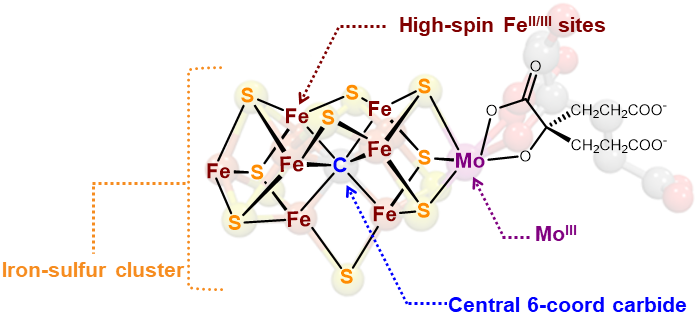
Background. Another synthetic modeling goal is the FeMoco active site of the enzyme nitrogenase. This fascinating enzyme contains a 6-coordinate, interstitial inorganic carbide (C4-) at the center of the active site cluster. The role of this carbide is thought to enhance the structural stability, magnetic coupling, and possible stabilization of high oxidation states during catalysis.
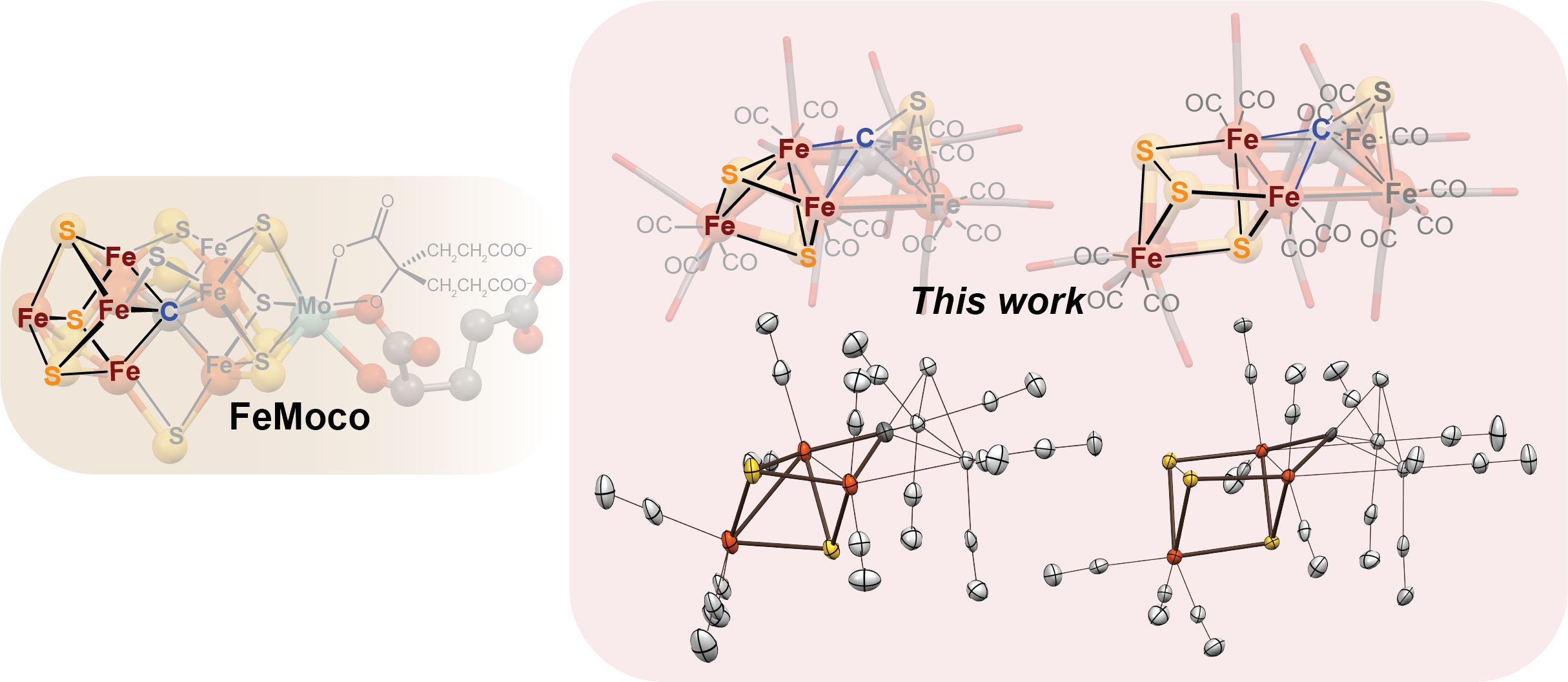
Authentic Iron-Carbide Clusters. However, the bio-inorganic molecular chemistry of the iron-sulfur-carbide cluster is limited by the lack of synthetic models that contain the purely inorganic carbide. We have developed synthetic methods to isolate some of the first Iron-Carbide-Sulfide and the first Iron-Carbide-Thiolate binding motifs (see below, Angew Chem 2021). We are now expanding these methods to develop structurally relevant and catalytically active clusters based on sulfide/phosphide ligation for N2 reduction to ammonia (NH3), as well as unprecedented nitrogen-transfer reactions.
Related Techniques include organic ligand synthesis, inorganic synthesis, X-ray crystallography, and inorganic spectroscopy (EPR, Mossbauer, NMR, UV/vis, XPS) and TD/DFT computations.